
America Has Become a Rogue Regime
As the American/Israeli war against Iran rages on for a third week, President Donald Trump and Secretary of Defense Pete Hegseth are resorting to increasingly violent rhetoric. They probably think that their chest-thumping and threats make them look macho and powerful. But they are presenting a brutal, barbaric image of America to the world. They are creating a dark stain on the US’ reputation.
And if their actions match their rhetoric, especially Hegseth’s, US forces might commit war crimes in Iran. Our government has already been acting like an outlaw regime, violating international law, and Hegseth seems determined to remove all constraints on the military.
In any event, the airstrikes might start to turn Iranians against the US, even if they hate their government, as civilian casualties mount and treasured cultural monuments like the Golestan Palace are hit. Although Hegseth and Trump love to brag about “the best military in the world”, US forces have made some grievous errors, such as bombing a girls’ school.
Incompetence and brutality are not a good combination for winning minds and hearts in the Middle East and the rest of the world.
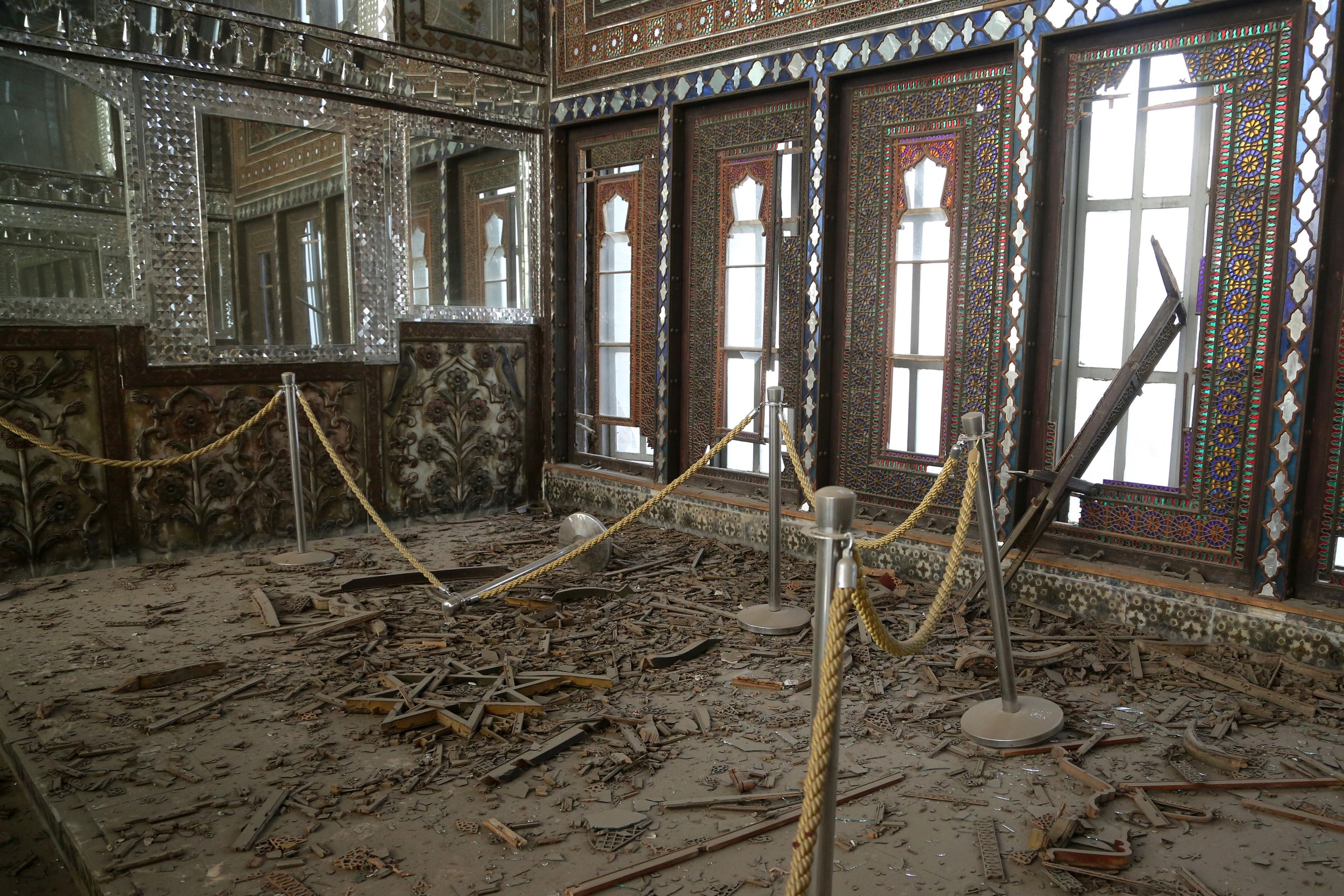
The heavily damaged Golestan Palace/photo: Getty Images
The Killer-in-Chief
Trump has set an ugly tone for his Administration’s approach to the war, which Hegseth has amplified. Trump has used vulgar terms to describe the Iranian regime, and he has glorified violence. This is not just inappropriate for a President; his harsh language could make it harder to negotiate an end to the conflict.
In a March 13 post on social media, Trump referred to Iran ‘s leaders as “deranged scumbags”. He added that “I am killing them” and that he was honored to do that. He sounded like a gangster, not a statesman.
“Watch what happens to these deranged scumbags today. They’ve been killing innocent people all over the world for 47 years, and now I, as the 47th President of the United States of America, am killing them. What a great honor it is to do so!”
One minor detail: Trump, who dodged the draft during the Vietnam War, is not killing anybody. He is sitting comfortably in his gilded Oval Office or fighting the sand traps on a golf course. It is unseemly that Trump is claiming credit for killing Iranian leaders.
The Chinese and the Russians are no doubt using Trump’s crude remarks as propaganda against the US, in their own countries and around the world. Vladimir Putin accuses Ukraine’s leaders of being neo-Nazis, which is vile, but at least he does not boast about killing his enemies.
Elsewhere In his post, Trump crowed about how the US was destroying Iran’s Navy, missiles and drones. In some respects, one should expect that from a Commander-in-Chief who is eager to claim victory…particularly because the war is going on longer than he expected. But Trump seemed to be missing the key point; he did not set forth any goals—lofty or not—that triggered his decision to launch the war.
“Stupid Rules of Engagement”
Defense Secretary Hegseth has proclaimed that US forces fighting Iran will not be constrained by “stupid rules of engagement”, as we discussed in an earlier article, King Donald Rushes Off to War. This is a sharp break from the US military’s traditional approach.
After some horrific mistakes in Afghanistan and Iraq that resulted in large civilian casualties, the Obama Administration tightened the rules of engagement. The Pentagon also established a group to find ways to minimize such deaths. This specialized unit, with roughly 200 members, included many soldiers with combat experience.
Last year, Hegseth slashed the team by 90%, to about 20 staffers.
Hegseth’s qualifications for leading the Pentagon are modest; he served in the military but not as a senior commander. Retired officers who had vastly more experience and responsibility than Hegseth have criticized his views about imposing constraints on military operations.
They believe that rules of engagement are needed for two reasons. The rules can help to avoid or minimize civilian casualties. Without such restraints, US forces might kill excessive numbers of civilians and alienate the local populace. Furthermore, if American troops adhere to high standards of conduct in waging war, the US has a strong moral argument for expecting its adversaries to observe the same rules. In other words, the restrictions help to protect our soldiers on the field of battle.
Unlike Hegseth, these retired officers believe that rules of engagement have not hobbled the US’ military operations.
Hegseth: “No Quarter”
On March 13, Hegseth gave a triumphant press conference detailing the extensive damage that the US and Israel had inflicted on Iran’s military infrastructure. Like his boss, Hegseth used coarse language to ridicule the Iranian leaders. He said that they had gone underground and were “cowering…that’s what rats do”.
In another snarky turn, Hegseth noted that Mojtab Khamanei, Iran’s new Supreme Leader, had not appeared in public or released a video recording of his remarks to the Iranian people. “You know why?”, Hegseth asked. “Because he is probably wounded or disfigured”.
Hegseth’s bombastic remarks sounded like propaganda, not a military briefing.
Then Hegseth appeared to cross an important line. The Secretary concluded his remarks by saying that the US would “keep pushing, keep advancing. No quarter, no mercy for our enemies”.
An order to “give no quarter” means “take no prisoners”, that is, kill them. International law and the US military manual explicitly ban such orders. Senior US military leaders support this ban partly because they want our soldiers to be treated well if they are captured.
Green Light for War Crimes?
Legal experts have denounced Hegseth’s statement as violating those standards and sending a dangerous signal to US forces. International law treats a “no quarter” order as a war crime, like targeting fighters who are wounded or trying to surrender. The US military has banned such orders since the Civil War.
Hegseth has not issued a retraction of his statement as of this writing.
Although it is unlikely, Hegseth might be ignorant about this critical military law and tradition. If so, he is incompetent. Otherwise, Hegseth seems to be encouraging US troops to commit war crimes, in which case he is morally bankrupt. Either way, he is not fit to lead the Department of Defense.
Glorifying War
The White House has released some disturbing videos that promote the Iran War. Here’s one example: the “Touchdown” video juxtaposes clips of NFL players tackling an opponent with footage of airstrikes on targets in Iran, including a loud “boom” after the hit. The 30-second montage jumps between several legendary tackles and the airstrikes, with rock music thumping in the background.
The film makes the airstrikes look like a video game and seems to equate war with an athletic contest. War is…cool.
But no one dies in a football game. The NFL players featured in the clips, who are retired, have complained bitterly about their images being used to promote war and killing.
Rank Incompetence
Trump and Hegseth share something else besides a love of bloodthirsty rhetoric. They are grossly incompetent.
· The Administration assumed that the Iranians would not close the Strait of Hormuz, the chokepoint for 20% of global oil shipments.
· The US launched an airstrike on a girls’ school because it was using outdated maps
· Airstrikes have badly damaged important Iranian cultural sites and residential areas
A Strait Jacket for Oil
One did not have to be a strategic genius to anticipate that the Iranians might block the Strait. US military leaders had developed plans around that threat for years. In February, numerous journalists discussed such a scenario, as speculation mounted about whether Trump would join Israel in attacking Iran. But in a major miscalculation, the Administration assumed that Iran would not resort to such a drastic step.
Asking NATO Allies for Help
This week, President Trump called upon some NATO allies to send warships to help the US escort vessels through the Persian Gulf and the Strait. Trump was tacitly admitting that the US may not have enough military assets to protect shipping in the Gulf and the Strait.
Trump seemed surprised that the Europeans reacted very cooly to his request. The German Defense Minister said, “This is not our war; we did not start it”. After all, NATO is a defensive organization, and it was the US, not Iran, that initiated the conflict. The war does not appear to trigger NATO’s Article 5, which commits its members to defend a fellow member that is attacked.
This turn of events is ironic, since Trump is asking for help from leaders of countries that he has hit with heavy tariffs and frequently insulted. He dissed them again on March 16, saying that NATO allies had failed “a great test” to help the US. Trump does not seem to realize that bullying other leaders can backfire.
A Disastrous Airstrike
Early in the war, a US warplane fired a Tomahawk missile at a building that turned out to be a girls’ school. The strike killed 175 people, including many children. The school was located close to a military installation. However, the property had been divided several years ago, and a wall was constructed between the school and military buildings. Two playing fields were placed near the school.
In planning the strike, the US used maps that had not been updated for several years. That is inexcusable in this age of satellite photography. We may have the best and most lethal military in the world, but apparently it is not the most careful.
If Hegseth had not disbanded the unit charged with reducing civilian casualties, its staffers might have asked the planners for “Operation Epic Fury” if all their maps were up to date.
Attacking Key Cultural Sites
Most Iranians despise the Islamic regime and would be ecstatic if it were overthrown. Logically, the US should avoid taking actions that would alienate them. Instead, either the US or Israel has struck cultural sites that are dear to Iranians, such as the Golestan Palace in Tehran, whose oldest sections date from the 16th Century.
The airstrikes have also damaged historical buildings around Imam square in Isfahan. In particular, the Chehel Sotoun Palace (Forty Columns) suffered significant damage. The Golestan Palace and Imam Square and its surrounding buildings are UNESCO World Historical Sites.
In Tehran, military and political buildings are often located near civilian and cultural structures. The provincial government headquarters was adjacent to Imam Square in Isfahan. So it is not entirely surprising that blast effects from bombs and missiles affected historical structures. But astute military planners and politicians might have decided to spare those structures, which are part of Iran’s heritage. Imagine if the Allies had bombed Notre Dame and the Louvre in World War II…how would the French have reacted?
And as the war grinds on, the US and Israel are destroying more apartment buildings, and more civilians are dying. If this continues, Iranians may start pining for the bad old days…
The Wall Street Democrat