
For those who enjoyed the Iraq War, President Donald J. Trump is now offering a splendid new adventure in nation-building.
Trump is basking in the glow of a brilliant military operation, and few will regret President Nicolás Maduro’s fall from power. The Venezuelan President was a cruel, corrupt and incompetent dictator who turned his country into a living hell.
However, the kidnapping of Maduro may turn out, like the invasion of Iraq, to be a tactical success but a strategic blunder. The President does not appear to have a plan for “running” Venezuela, other than issuing orders to the government in Caracas, which he assumes will obey his commands. Chaos and civil war are not inevitable, but they are certainly possible.
The US has no plausible legal justification for its campaign against Venezuela. One might like the result--the removal of a tyrant--but Maduro’s abduction represents another brazenly lawless act by Trump.
The President seems to accept the idea, promoted by the Russians and the Chinese, that the world should be divided into three spheres of influence. He is acting like a Mafia Don protecting his turf…and extorting the locals.
If the US can invade a country that does not threaten it, why can’t Russia and China? Trump may just have given China a green light to take over Taiwan. His blatant disregard of international law helps Russia justify its war on Ukraine.
Parallels with the Iraq War
There are some striking similarities between Trump’s attack and President George W. Bush’s war in Iraq.
Bush justified his invasion of Iraq by claiming falsely that Saddam Hussein had weapons of mass destruction. Trump has based his campaign against Maduro on wild accusations that he heads a criminal enterprise that traffics vast amounts of fentanyl and cocaine as a way of attacking the US. Trump also has alleged that Maduro is sending Venezuelan gangs like Tren de Aragua to the US to kill Americans, but US intelligence agencies have refuted that.
In another parallel with Bush, Trump does not seem to have thought through the long-term consequences. He seems to assume that the Venezuelans will be so cowed by US military might that they will do whatever he demands…like forking over a lot of their oil revenues. If not, threats of assassination might be persuasive, it seems. When a journalist asked Trump whether the new Venezuelan leader, Delcy Rodríguez, would cooperate with the US, he said, “if she doesn’t do what’s right, she is going to pay a very big price, probably bigger than Maduro.”
Like Bush, Trump is ignorant about the region’s history. To Bush’s surprise, Iraqis did not toss flowers at American soldiers who were “liberating them”. Although most Venezuelans despise Maduro, they would probably resent an occupation by US troops to carry out Trump’s scheme to “make a lot of money” from Venezuelan oil. They—and many other South Americans--may seethe in anger as they watch the latest in a long series of US interventions in the Western Hemisphere.
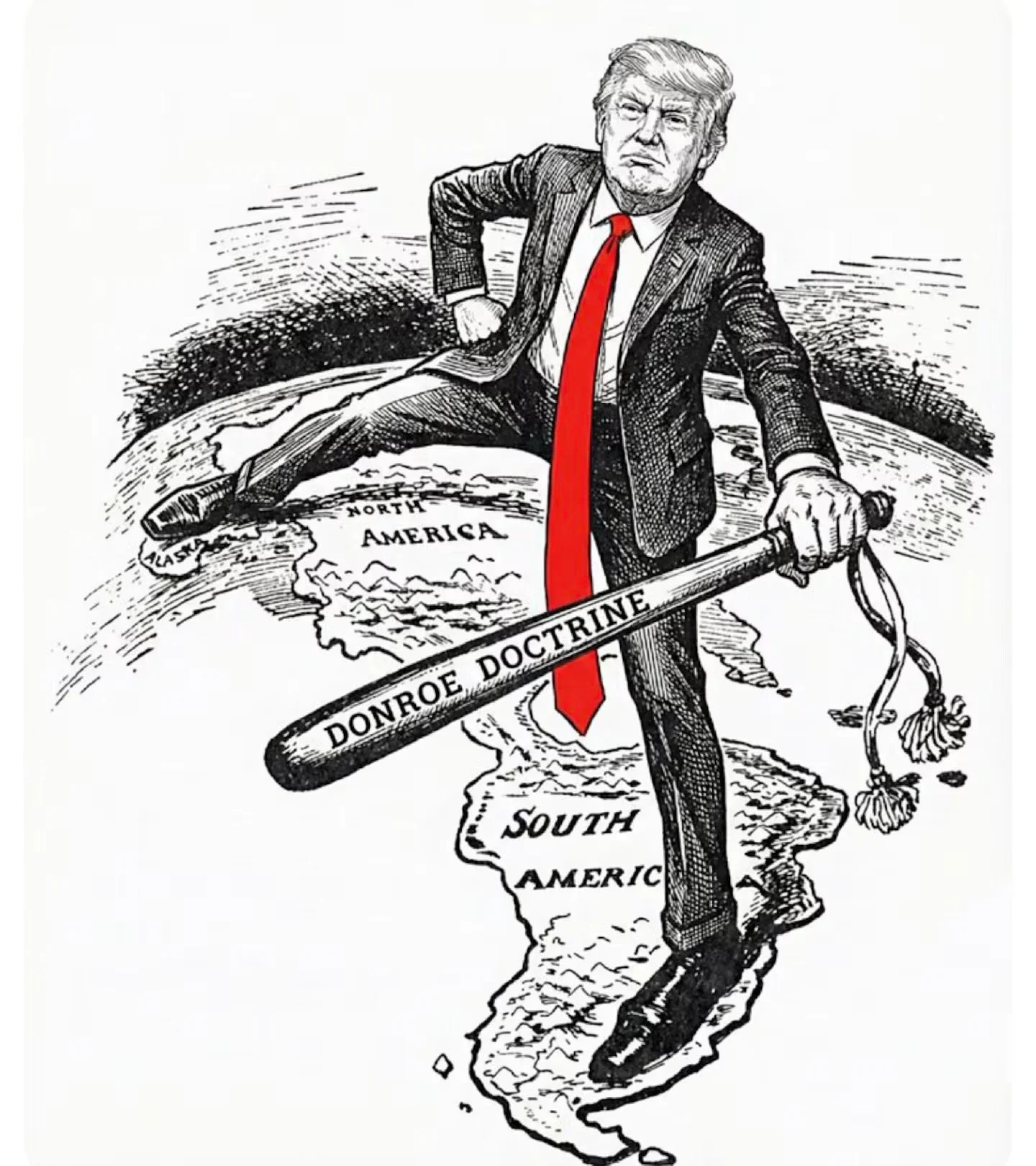
Talk loudly and carry a big bat /source: Trump Rapid Response Team via the Daily Beast
Key Differences with Bush
Nonetheless, there are some important differences in the way Bush and Trump approached war.
Bush tried to create a plausible basis for his invasion, so he could rally public opinion in support of waging war on Iraq. Unfortunately, many Americans accepted his lies about weapons of mass destruction.
Trump has tried out various rationales for attacking Venezuela, but they have not worked. His claims about Maduro using drugs as a weapon against the US obviously do not jibe with reality, as journalists have pointed out repeatedly. Trump has not won the battle for public opinion; most Americans do not want war with Venezuela. Many, if not most, of Trump’s “America First” supporters have firmly opposed any foreign wars. That is a key reason they voted for him.
But Trump does not care what the voters think.
Congress’ Role
Here is another crucial distinction between Bush and Trump. Bush respected the separation of powers. He asked Congress to authorize his campaign against Saddam Hussein, and it did.
Trump cannot be bothered with such niceties. He did not seek approval from Congress for the attack; in fact, he did not even consult with Republican leaders. At the press conference last Saturday on the abduction, Secretary of State Marco Rubio said that it would have jeopardized the mission if he and his colleagues had discussed it with Congress in advance. His remark encapsulated the Administration’s contempt for Congress. Trump added, smirking, that people in Congress tended to leak.
But, as we know, the Constitution clearly vests the power to declare war in Congress, not in the executive branch. Although Presidents have conducted limited military strikes without such approval, they have not invaded other large countries without a go-ahead from Congress.
Furthermore, previous Administrations routinely discussed highly classified matters with the House and Senate Intelligence Committees, and its members did not leak those discussions.
These are flimsy excuses by a President who believes that he has the absolute authority to do “whatever I want”. By giving himself the power to launch a war, Trump has taken yet another step toward turning the US into a banana republic.
Who Needs Democracy?
Bush said that the US would replace Hussein’s dictatorship with a thriving democracy. This was his second most important rationale for invading Iraq. In a sharp contrast, Trump has not even mentioned restoring democracy in Venezuela. Instead, he threw Maria Corina Machado, the leader of the Venezuelan opposition, under the bus:
”She’s a very nice woman, but she doesn’t have the respect within the country.”
In fact, Machado enjoys wide support within Venezuela. In the 2024 presidential election, a candidate standing in for her won about 70% of the vote.
One big problem, at least for Trump: Machado won the Nobel Peace Prize last year. He did not.
Who Needs Coalitions?
Bush worked assidously to build an alliance of several nations—the “coalition of the willing”—against Iraq. In an infamous episode, he sent Secretary of State Colin Powell to persuade the United Nations that Hussein was endangering the Middle East.
Trump and Rubio have not made any effort to build a coalition against Venezuela, whether in Latin America or elsewhere. Instead, on Saturday they issued veiled threats against Colombia, Cuba and…Greenland (again). The Administration has put the US’ NATO allies in a deeply embarrassing situation, with its flagrant violations of international law and its renewed threats to take Greenland away from Denmark, a NATO member.
Whose Oil Is It, Anyway?
Trump has cited gaining access to Venezuela’s oil reserves as a key reason for toppling the Maduro regime. But George Bush downplayed the role of Iraq’s oil as a factor in his decision to invade the country.
After the US invaded Iraq, many critics accused it of invading the country primarily to gain control of its oil reserves. The Bush Administration was very sensitive to such criticism. US officials took pains to assure that energy companies from other countries could compete equally with American firms when they bid to develop Iraqi oil properties.
The situation in Venezuela is complicated. In 2007 then-President Hugo Chávez drastically restructured his country’s contracts with three US oil firms, expropriating a large amount of their assets in Venezuela. Chevron chose to remain in Venezuela. ExxonMobil and Conoco decided to leave the country and sued Venezuela. They were awarded billions of dollars in compensation via arbitration, but Venezuela never paid those awards in full.
However, when Trump talks about “the oil that was stolen from us”, it sounds as though the US government is a collection agency for ExxonMobil and Conoco. This is particularly offensive in Latin American countries, where under the law, oil and other natural resources belong to the state, not to individuals. Oil is a national asset and a source of national pride. Foreign companies enter joint ventures with a state-owned entity to exploit and develop the natural resources; it is not “their oil”.
Trump’s crass, imperialistic attitude will probably trigger memories of the bad old days when Uncle Sam sent troops into various Latin American countries to protect “our” bananas, “our” minerals and other resources.
The Real “Donroe Doctrine”
Trump flatters himself that he has improved upon the Monroe Doctrine, by turning it into a more muscular version that he calls the “Donroe Doctrine”. Under this notion, the Western Hemisphere is the US’ sphere of influence, and it can intervene wherever it chooses. Furthermore, China should not challenge the US’ dominance in this realm.
There is an implicit corollary: Trump apparently agrees with Vladimir Putin and Xi Jinping that the world should be divided into three spheres of influence. Russia gets Europe, China rules Asia, and the US runs Latin America.
The Donroe Doctrine seems to have two other elements:
· Pick on countries that are smaller than your own—preferably much smaller
· Be nice to large, powerful countries and do what they tell you to
Like all bullies, Trump pushes around weaker rivals and kowtows to stronger ones. What do Greenland, Venezuela, and Panama have in common? They are much weaker than the US, in terms of population, economic clout and military power.
What do Russia and China have in common, besides being run by dictators? They have massive armies and, in China’s case, substantial economic leverage over the US. Oh, and they have nuclear weapons, too.
If Trump really were a good dealmaker, he would be adamant about keeping Europe within the US’ sphere of influence, rather than settling for the Western Hemisphere, if only for purely commercial reasons. After all, the European Union’s $22 trillion gross domestic product is about five times that of all South America. Trump would also want to preserve the US’ large presence in East Asia. The GDP for East Asia, excluding China and India, is about $10 trillion.
Instead, Trump is opting for an America Third strategy. Carry a big bat, but think small.
The Wall Street Democrat