
What Does Orban’s Defeat Mean for Trump?
After 16 years in office, Prime Minister Viktor Orban has lost his grip on power, as Hungarians rejected his “illiberal democracy” and voted in favor of...real democracy. Orban’s defeat has massive implications for Hungary and Ukraine; he was Putin’s key ally in Europe. His downfall is also a blow to the American far right, which idolized Orban and wanted to copy his authoritarian system.
Orban lost the election mostly because of a poor economy and rampant corruption. Fed-up Hungarians no longer responded to his tirades against immigrants and his supposed defense of Christian values. His defeat should be a wake-up call for Donald Trump, who has assiduously followed Orban’s playbook for installing one-party rule, as I discussed in Moscow on the Potomac?
But will Trump absorb the wrong lesson? Will Trump modify his policies, or will he double down on his efforts to control the midterm elections?
The opposition leader, Peter Magyar, conducted an energetic race, focusing primarily on pocketbook issues and corruption’s impact on ordinary Hungarians. Magyar also attacked Orban’s authoritarian regime, and, unlike his opponent, he is a devout Catholic, which appealed to many voters. Magyar traveled throughout the country, speaking in rural areas as well as cities. Will Democrats in the US learn from his campaign?
It’s the Economy…and Corruption
Orban has badly mismanaged the Hungarian economy, partly because of the distortions caused by massive corruption. Hungary is much poorer than Western Europe, and for several years under Orban the country received large subsidies from the European Union. However, in 2022, the EU finally lost patience with Orban and suspended the subsidies because of his anti-democratic maneuvers.
Economic growth became anemic, reaching only 0.4% in 2025, and unemployment reached a 10-year high. Inflation surged, compounding the misery. Furthermore, the government failed to maintain essential infrastructure, particularly the public health system. Hungarians even had to bring their own toilet paper to financially strapped hospitals.
Meanwhile, Orban and his circle of oligarchs built luxurious mansions—a point that Magyar constantly emphasized.
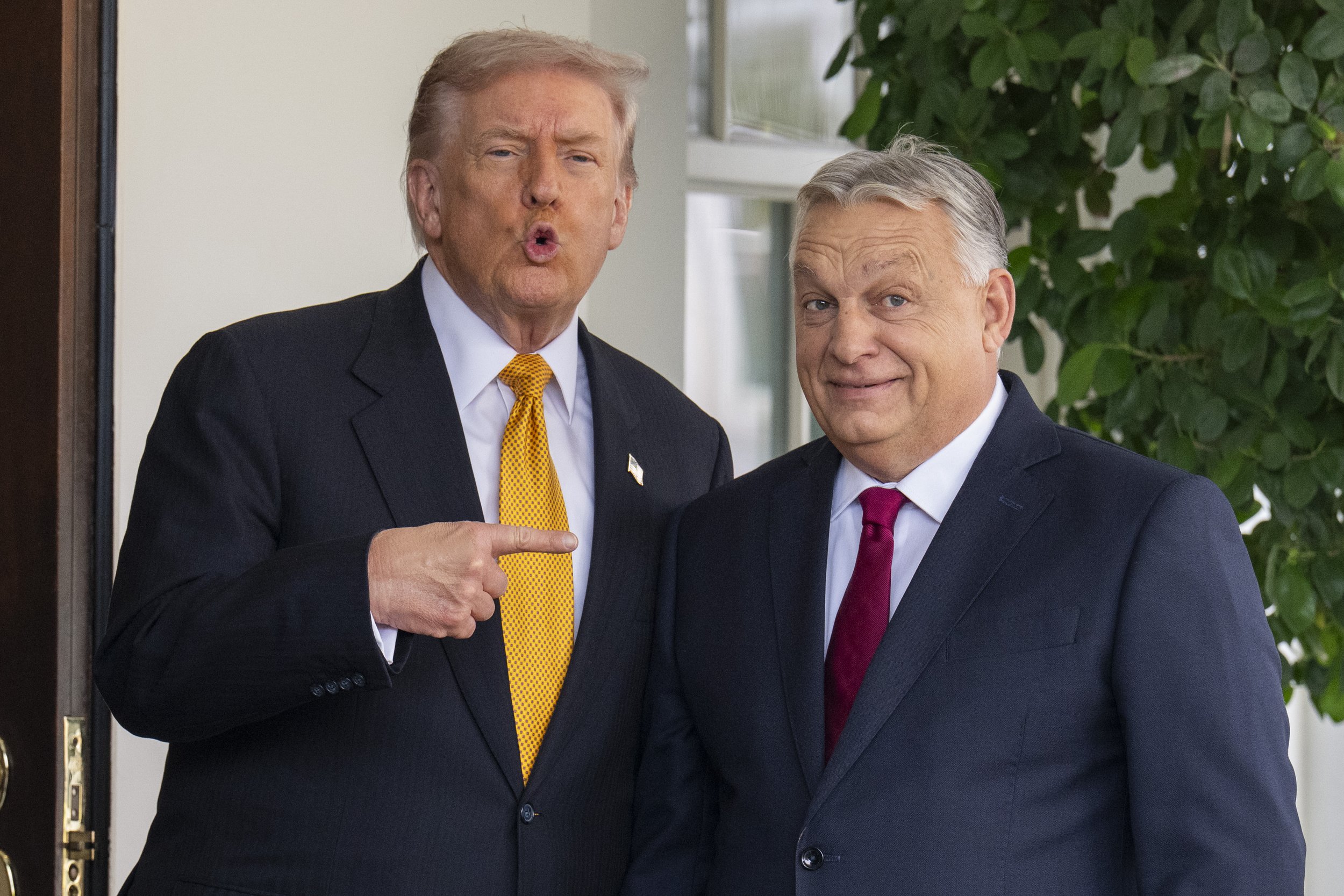
Donald Trump and his BFF Viktor Orban / photo: Getty Images
Restoring Democracy in Hungary…Perhaps
Peter Magyar’s Tisza Party won a smashing victory, taking over two-thirds of the seats in Parliament. (Tisza means “Respect and Freedom”, and Magyar means “Hungarian”. Names can have power.) With such a large majority, perhaps Magyar can enact reforms that will begin to restore democracy in Hungary.
However, Magyar will face an entrenched and hostile “deep state”. Over the last 16 years, Orban systematically dismantled most of the country’s democratic institutions, and he staffed government agencies and the judiciary with his apparatchiks. They may be hard to dislodge. Still, it is encouraging that Magyar has already called for the heads of the judiciary and government agencies to resign, signaling that he intends to clean house.
Magyar has also said that Hungary will rejoin the European Public Prosecutor’s Office, an arm of the EU that investigates financial crimes. That would allow EU investigators to probe the business dealings of Orban’s cronies, especially his son-in-law, who became remarkably successful during Orban’s reign.
Orban cemented his hold on power partly by forcing his political opponents to sell their businesses, such as media properties, to Hungarian oligarchs at very low prices. Orban also improperly distributed EU assistance funds to his cronies so they could buy up Hungarian farmland.
Big Boost for Ukraine
Orban’s fall from power could help Ukraine significantly. The Hungarian leader took Russia’s side in its war against Ukraine, and he frustrated the other members of the European Union by consistently voting against aid for Kyiv. Orban repeated Kremlin talking points and issued dire warnings that Hungary could be dragged into the war. In effect, Orban contributed to Russia’s propaganda campaign against Ukraine.
His intransigence delayed a number of EU assistance packages for Ukraine for several months, until Orban relented, having secured special benefits for Hungary. This was particularly egregious because Hungary was not required to contribute to those programs, since it is one of the poorest members of the EU.
However, in the latest go-round, Orban refused to budge, blocking a 100 billion Euro package from the EU. Ukraine desperately needs this aid, because when Trump returned to power, he refused to provide any new assistance to Kyiv.
Magyar is a conservative, but he is democratic and anti-Putin. The new leader has indicated that he will not block EU assistance to Ukraine.
Setback for the American Far Right
Orban has been an icon for the American far right, which has a stranglehold on the Republican Party. These conservatives have cheered him on as he railed against gay people and immigrants, often in highly racist terms, and (supposedly) supported traditional Christian “family” values. They endorsed his “illiberal democracy”, with its extreme gerrymandering, controlled press and politicized judiciary. Why? Because Orban’s system enabled a minority party to implement a far-right agenda that most voters opposed.
This is the far right’s vision for America. They admire the Hungarian leader so much that they have held their Conservative Political Action Conference five times in Budapest, often featuring Orban as a keynote speaker.
Did Trump’s Intervention Backfire?
Donald Trump, one of Orban’s biggest fans, invited him to the White House in 2019, over the strident objections of senior aides. George W. Bush had ducked a meeting with Orban, and the Obama Administration snubbed him because of his anti-democratic behavior.
Trump met again with Orban at the White House in November 2025. He lavished praise on the Hungarian leader, saying:
“He’s done a fantastic job. He’s a very powerful man within his country ... He’s run a really great country, and he’s got no crime, he’s got no problems, like some countries do.” –Donald Trump, Nov. 7, 2025
When it became clear that Orban might lose the election, Trump dispatched Vice President J.D. Vance to Hungary to bolster the Prime Minister. However, that may have backfired, as Trump and Vance have become very unpopular among mainstream European voters.
Furthermore, Hungarians living in large towns and cities—centers of opposition to Orban’s rule—are probably keenly aware that Trump has also pursued bad economic policies (such as his tariffs) and has presided over an extraordinarily corrupt administration. That may have reinforced their grievances against the Orban regime and contributed to the massive (80%) turnout in the election.
Orban’s Political Odyssey
Orban first became Prime Minister in 1998, as a conventional, even leftist, politician. But when he lost an election in 2002, it was such a shock that it soured him on democratic practices.
After brooding for eight years, Orban returned to power in 2010, a changed man. The Prime Minister immediately attacked the key institutions of Hungarian democracy and civil society, seeking to minimize any constraints on his power.
Orban used financial pressure to force independent newspapers and media companies to sell out to his hand-picked bidders. They promptly turned those outlets into government propaganda organs. The Prime Minister punished judges who ruled against the government, and he soon controlled the judicial system.
The Prime Minister also attacked universities, particularly the Central European University founded by George Soros, because they were centers of critical, independent thinking. Eventually, after years of harassment, the CEU moved to Vienna. Professors at public Hungarian universities learned that it was safer not to criticize the government. Dissent became rare.
Following the Autocrat’s Playbook
Trump has borrowed the script for his second administration from Orban’s playbook.
In his first term, Trump savagely attacked immigrants and the free press; he and Orban have always been aligned on those issues. But in his second term, Trump has openly tried to mimic Orban’s tactics—financial pressure and harsh propaganda campaigns--to subjugate the media and universities. He has failed to curb the independence of Federal judges, however, because they have life tenure.
Like Orban, Trump has tried to redraw electoral districts to stack the deck against the opposition party. The President demanded that Republican state leaders rewrite voting maps so that Republicans would keep control of the House in November. This was an unprecedented move to gerrymander voting districts in mid-decade.
Trump has cultivated a group of extremely wealthy businessmen, mostly from the tech industry. Trump has reveled in blatant displays of corruption, enriching his own family and gaining new allies. Like Orban, he is building a circle of loyal oligarchs who depend on his good graces.
Flashing Red Lights for Trump
In another parallel with Orban, Trump has lost touch with American voters. He won the 2024 election by promising to improve the economy and reduce inflation; in fact, he pledged to reduce prices. Those promises, and Americans’ concerns about Joe Biden’s mental acuity and immigration policy, helped Trump pick up critical support from Latino and Black men. They provided much of his margin of victory.
But Trump’s policies—the tariffs, massive deportations, terminating green energy projects--have retarded economic growth and stoked inflation. Harsh ICE sweeps have further alienated Hispanic voters. His anti-DEI initiatives have targeted programs that honored or helped African Americans, who have no doubt taken notice. Trump’s poll numbers are abysmal.
Nevertheless, so far the President does not seem willing to make mid-course policy corrections that might win back voters. Instead, he has launched a highly unpopular war—breaking another key promise—that is causing energy prices to soar.
Danger of a Coup
Orban’s lossshows that it is possible to defeat an autocrat despite his attempts to stack the deck against his opponents. To his credit, Viktor Orban accepted the voters’ verdict and promptly conceded that he had lost the election. But as we know, that is not Donald Trump’s approach.
The clear and present danger is that Trump may decide to interfere with the midterm elections, pulling out all the stops to prevent the Democrats from winning.After all, the only thing that would prevent him from doing that is his “morality”.
The Wall Street Democrat