
President Donald Trump seems prepared to go to war with Venezuela. Why is he so focused on a country that does not pose any threat to the United States?
Trump has dreamed of overthrowing the Venezuelan government for years. In 2017, during his first term, the President said that he was “not going to rule out a military operation” against Nicolas Maduro, Venezuela’s despotic ruler. That turned out to be a hollow threat.
But this time, Trump seems serious. The President ordered the Navy to move the USS Gerald Ford, its largest, most advanced aircraft carrier, from the Mediterranean to the Caribbean. The carrier serves as the flagship for a fleet of 15 ships. The US military has amassed 15,000 soldiers and sailors in the Caribbean. Trump has declared that Venezuela’s air space “has been closed” and that US troops might conduct operations inside the country.
This week, American forces seized an oil tanker off the coast of Venezuela. Although the details are murky, the Administration may have conducted this operation as another way to put pressure on Venezuela, which depends on oil exports for most of its revenue.
In his campaigns Trump ran against intervening in other countries, as part of his “America First” agenda. In the 2024 election, voters did not give Trump a mandate to invade Venezuela. The MAGA crowd hates the idea of foreign wars.
So what gives?
A Reality Check
First, let’s dispose of the fantasies that Trump has spun about the Maduro regime:
Venezuela is not a military threat to the US. Our armed forces have attacked small boats, 20 to 30 feet long, which were far from our coast. The Administration claims that the boats were transporting illegal drugs. Even if that is true, they were probably being used to transport cocaine to Trinidad and other islands, where their cargos are loaded onto larger vessels for shipment to Europe.
Venezuela gangs smuggle drugs into the US, but that is not their primary market. They traffic in cocaine, not fentanyl, the drug that is the leading cause of deaths from overdoses in the US. They ship the cocaine mostly to Europe, rather than the US. Fentanyl comes from China; it is processed in Colombia and Mexico, and it is usually transported via the Pacific, not the Caribbean.
The Maduro regime is a cruel, corrupt dictatorship, but it does not control Tren de Aragua or other Venezuelan gangs.
Maduro is not a gang leader. He is a thug, and he probably is keenly aware that top military officers may be involved in the drug trade. But Maduro depends on the armed forces to stay in power, so he looks the other way. This is not to defend his conduct or regime; the point is that his government is not using drugs as an indirect way to attack the US.
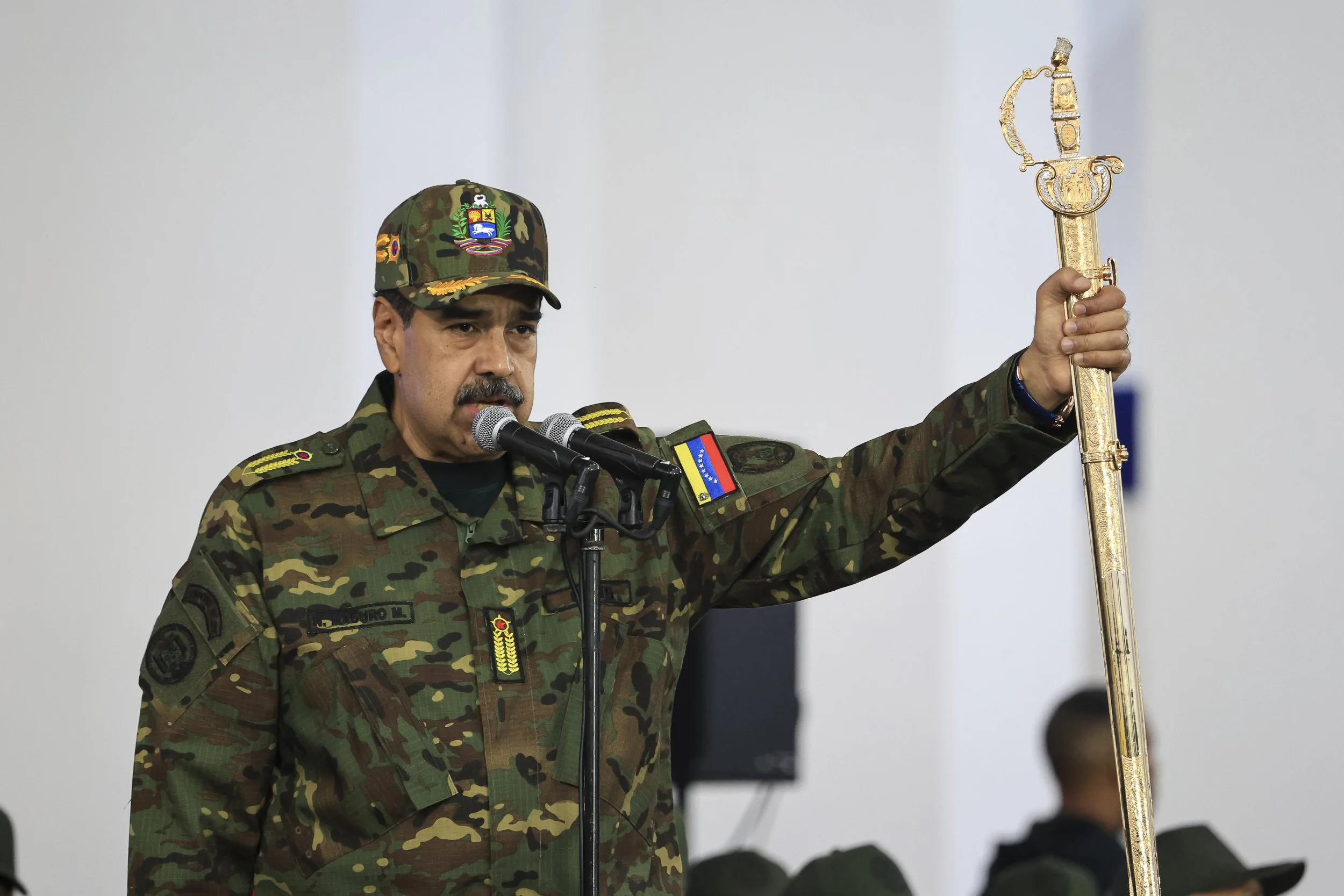
Venezuelan President Nicolás Maduro
Myths About Venezuelan Immigrants
Trump has also spewed a web of lies about the waves of immigration from Venezuela.
Here are the facts:
The Maduro regime has not opened its prisons and insane asylums and shipped criminals and mentally ill people to the US, as Trump claims. Instead, Maduro has completely mismanaged the economy and tolerated a huge amount of corruption, which has turned his country into a living hell. Living standards have plummeted; it is hard for ordinary citizens to obtain the necessities of life, such as medicine.
Desperate Venezuelans have voted with their feet, leaving the country. About eight million people, roughly 25% of the country’s population, have fled Venezuela over the last 11 years.
Colombia and Peru, not the US, have absorbed the largest number of Venezuelan refugees.
Immigrants, whether legal or not, have not caused a crime wave in the US. They have a lower crime rate than native-born Americans. That’s logical, when you think about it. The last thing an undocumented immigrant wants is a run-in with the police.
A Corrupt Dictatorship
The relationship between the US and Venezuela has been antagonistic for at least 25 years, after Hugo Chavez, Maduro’s predecessor, came to power. Chavez routinely insulted American Presidents, from George H.W. Bush to Barack Obama, often using very coarse language.
A nationalist and a socialist, Chavez expropriated American oil companies. He seized control of Petróleos de Venezuela, the national oil company, which had been an efficient, well-run operation, and he staffed it with incompetent cronies. As a result, PDVSA started to incur large losses. That was quite an achievement, given that Venezuela has the largest oil reserves in the world.
Chavez gradually undermined Venezuela’s democracy, but he remained popular with most voters and legitimately won elections. Maduro served as Chavez’ Vice President. When Chavez died in 2013, Maduro succeeded him. However, Maduro lacks Chavez’ charisma and political talents, and he has dismantled the vestiges of his country’s democratic institutions.
Stealing an Election
The opposition candidate, Edmundo González, won the Presidential election last year by a landslide. González was a stand-in for Maria Corina Machado, the leader of the opposition party, whom the government had barred from running. Maduro ignored the results and declared himself the winner, stealing the election.
Ms. Machado was awarded the Nobel Peace Prize for mounting her campaign against Maduro; her daughter accepted the Prize on her behalf in Oslo this week.
For a normal American administration, Venezuela would provide a powerful PR opportunity to extol the virtues of democracy and capitalism compared to dictatorships and socialism. Leaving aside humanitarian concerns, the best course for Trump would be to leave the Maduro regime alone and use its failures for propaganda purposes.
Why is Trump throwing away this gift, threatening war and making the US look like the bad guy?
A Frustrated Bully
From Trump’s point of view, Venezuela may appear to be a relatively easy target. It’s easier for the President to act like a tough guy with Maduro than with Putin or Chinese President Xi Jinping, who control massive armies.
Despite his proclamations, it looks like Trump will not extend his rule over Canada, Greenland or Panama. Their citizens do not seem inclined to become his subjects. These setbacks must be very frustrating for the President, who apparently agrees with Putin and Xi that the world should be carved up into three spheres of influence: Trump runs the Western Hemisphere, while Putin dominates Europe and Xi rules Asia.
One might wonder why the President is willing to cede two-thirds of the world to Putin and Xi. That is a lot of real estate and, to use Trump’s terminology, the arrangement looks like a terrible deal for the US.
The European Union, as a collective entity, is the US’ largest trading partner; it is far more important than Latin America in commercial terms. (The US’ biggest single-country trade relationships are with Canada, Mexico and China).
Asian economies are the fastest growing in the world. Japan and Taiwan are also key trading partners for the US, and Taiwan’s chips are crucial for our tech industry. But as usual, Trump is thinking short-term, and he is thinking small.
Trump is Fading
Finally, it is obvious that Trump’s mental and physical powers are waning. The video clips of the President dozing off—several times—during a Cabinet meeting, in front of all the cameras, are a flashing red light. Gov. Gavin Newsom (D-CA) nailed it with his “Dozy Don” nickname.
Here’s the danger: Trump has always prided himself on his strength and energy; those traits are core to his “brand”. Now, he may try even harder to look like a strongman by striking at Venezuela. Like Peter Hegseth, his hapless Secretary of Defense, Trump may be desperate to look like a tough guy…and take reckless risks that trigger a war with Venezuela.
A Side Show
The conflict with Venezuela is a distraction, a side show. The US’ biggest strategic challenge, right now, is helping Ukraine defend itself and preventing Russia from overrunning Eastern Europe.
But Trump has not lifted a finger to assist the Ukrainians. Instead, he moved the USS Gerald Ford carrier, drawing down US forces in Europe. That sent yet another signal to Putin that Trump won’t interfere with his invasion.
As a thought exercise, what if Trump had kept the carrier in the Mediterranean and moved it closer to the Bosphorus, the waterway that leads to the Black Sea and Ukraine? What if he had deployed 15,000 troops to Poland? Those moves would have shown support for Ukraine and given President Volodymyr Zelensky more leverage in his negotiations with Putin.
Another Endless War?
As I suggested earlier, Trump may consider Venezuela an easy target. But that could be wishful thinking or blind ignorance. The President often seems detached from reality these days, and his coterie of yes-men and yes-women won’t tell him that it would be foolish to invade Venezuela.
US forces could probably overwhelm the Venezuelan air force and navy and launch devastating strikes on key military installations. If Trump sends the Marines into Caracas, they might be able to capture Maduro and topple his regime.
But what would happen next? The Venezuelan army has 63,000 soldiers, and the generals have run the country for over 30 years. This has been a highly lucrative arrangement for them, and they may not simply lay down their arms. What if they start a guerrilla war against the “Yankee imperialists” …and the Venezuelan people rallies to the cause?
Trump loves to blame Democrats (rather than George W. Bush) for getting the US bogged down in “forever wars” in Afghanistan and Iraq. If he invades Venezuela, he could make the same mistake.
Losing the Moral High Ground
Trump’s attacks on speedboats in the Caribbean violate US military law and international law. The 80-plus people killed so far might have been running drugs--although the administration has not proven that--but they were civilians, not combatants. There is simply no justification for killing them, rather than detaining them. If police officers see drug dealers on the street in an American city, they arrest them. They do not shoot them.
When journalists criticize the attacks on the speedboats, they usually refer to them as “extrajudicial killings”. That is a euphemism for murder: the US is brazenly killing civilians on the high seas. This is wrong, illegal and a stain on the US’ reputation. The US has lost the moral high ground. It’s harder to criticize Putin’s ferocious assaults on Ukrainian cities if American forces are targeting civilians.
“Gunboat Diplomacy” Does Not Win Friends
Americans have believed for centuries that they have an innate right to dominate the Western Hemisphere. As early as 1823, President James Madison warned European nations not to interfere in the Western Hemisphere because it was within the US’ sphere of interest. His rather audacious declaration came to be known as the Monroe Doctrine.
Since then, numerous Presidents have sent troops to invade Latin American countries or taken other steps to overthrow governments that they opposed. There is a long, bloody history of American interventions, from the Mexican American War (1846-48) to President Ronald Reagan’s invasion of Grenada in 1983. These were not glorious chapters in US history, and Latin Americans have deeply resented the incursions by “los Yanquis”.
The Maduro regime does not have many friends among other Latin American countries. Colombia and other nations have had to deal with a large influx of desperate refugees from Venezuela. But when Trump talks about regime change in Venezuela, he triggers painful memories for Latin Americans of the US’ frequent incursions.
No Longer the US’ Backyard
Meanwhile, the Chinese stay out of politics in the Western Hemisphere, mostly. They cultivate their relationships with countries such as Brazil and Argentina by buying huge amounts of their crops. Chinese firms are building infrastructure projects in South America and constructing some factories, notably in Brazil. Their economic clout is large and growing. The Western Hemisphere is no longer the US’ backyard.
Don’t cry for us, Venezuela. No one has forced us to be so stupid.
The Wall Street Democrat